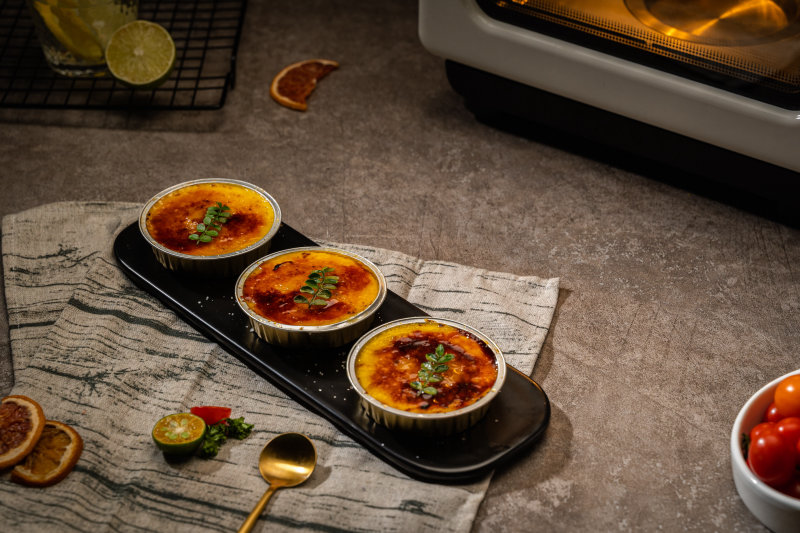
Custards, crème brûlée, sticky toffee pudding—steam ovens create a moist, stable cooking environment that's perfect for desserts. These five recipes showcase why steam is the dessert world's best-kept secret.
Why Steam Is the Dessert Secret
Professional pastry kitchens have long used steam for delicate desserts. The moist, even heat prevents the surface cracking that plagues crème brûlée and custard, produces impossibly silky textures in cheesecakes, and keeps cakes dome-free and perfectly level. Your steam oven brings these professional techniques home.
The key advantage is control. In a conventional oven, there's a constant battle between the dry outer air and the moist interior of a baking dessert. This causes the edges to set and cook faster than the center, leading to the cracked, domed, or sunken textures that plague home bakers. A steam oven surrounds your dessert with consistent moisture, ensuring even cooking throughout.
1. Crème Brûlée: The Impossible Made Foolproof
Crème brûlée is notoriously difficult in a conventional oven. The water bath (bain-marie) helps, but the dry oven air still causes the edges to overcook before the center sets. The result is often cracked, grainy, or with an unpleasant rubbery skin.
In a steam oven, the custard cooks in a sealed humid environment. The top doesn't skin over, the edges don't overcook, and the entire custard sets at the same rate. The result is a perfectly smooth, creamy custard with a liquid center that jiggles like jelly when shaken.
The method: Preheat to 200°F (93°C) in pure steam mode. Fill ramekins with your favorite custard base (6 egg yolks, 1/3 cup sugar, 2 cups heavy cream, 1 tsp vanilla). Set the ramekins in a deep pan and add hot water halfway up the sides. Steam for 45-50 minutes until the edges are set but the center still wobbles. Refrigerate overnight. Before serving, sprinkle with sugar and torch to caramelize.
2. Sticky Toffee Pudding: The British Classic Done Right
Sticky toffee pudding—a moist sponge cake made with chopped dates, bathed in toffee sauce—is one of Britain's greatest contributions to dessert. The problem is that most home versions emerge from conventional ovens dry and dense rather than the impossibly moist, sticky, indulgent experience it should be.
Steam the pudding portions in individual molds or a large cake pan. The steam keeps the cake extraordinarily moist while cooking it evenly throughout. After unmolding, the toffee sauce—warm and salted—permeates every bite.
The method: Make a batter with 200g chopped dates, 200g self-rising flour, 200g butter (softened), 200g brown sugar, 3 eggs, and 1 tsp bicarbonate of soda (dissolved in 2 tbsp hot water). Pour into a buttered cake pan. Steam at 200°F (93°C) for 75-90 minutes until a skewer comes out clean. Serve warm with warm toffee sauce (200g butter, 200g brown sugar, 200ml double cream, pinch of salt, simmered until thickened).
3. Japanese Cotton Cheesecake: The Cloud-Like Dream
Japanese cotton cheesecake differs from its New York counterpart: it's lighter, airier, and has a distinctive custard flavor from the large number of eggs relative to cream cheese. It also has a fragile structure that collapses easily in a dry oven.
The steam oven's humid environment keeps the cheesecake's delicate foam structure intact during cooking. The result is a cake that wobbles like jelly, melts on the tongue, and has almost no "baked" flavor—just pure, clean cheesecake essence.
The method: Beat 250g room-temperature cream cheese until smooth. Add 6 egg yolks, 80g sugar, and 1 tsp vanilla. Fold in 60g cake flour and 20g cornstarch. In a separate bowl, beat 6 egg whites with 80g sugar to stiff peaks. Fold into the cheese mixture in three additions. Pour into a 9-inch springform pan. Place in a deep roasting pan and add hot water to come halfway up the sides. Steam at 285°F (140°C) for 50-60 minutes until the center jiggles slightly. Cool in the oven with the door cracked open for 30 minutes to prevent collapse.
4. Chocolate Fondant: The Center That Flows
A chocolate fondant—popularized by Michel Roux—is the ultimate restaurant dessert: a warm cake with a liquid center that flows out when you cut into it. The challenge is timing: the exterior must set while the interior remains molten. Even a minute too long and the center is gone.
Steam cooking gives you more control over this delicate balance. The humid heat penetrates more evenly, allowing you to cook the exterior to doneness without overcooking the center. The result is a fondant that holds its shape perfectly while delivering that gloriously gooey chocolate center.
The method: Make a batter with 200g dark chocolate (70%), 200g butter, 4 whole eggs plus 4 egg yolks, 200g icing sugar, and 100g flour. Butter and flour individual molds, then fill 3/4 full. Refrigerate until ready to bake. Preheat steam oven to 210°F (99°C). Bake fondants for 12-14 minutes—they should be set on the outside with a slight wobble in the center. Invert immediately onto plates.
5. Steamed Gingerbread with Sticky Pecan Sauce
Gingerbread doesn't have to mean cookies. A steamed gingerbread loaf—dark, sticky, fragrant with ginger, cinnamon, and molasses—is a revelation that bears little resemblance to its cookie counterpart. The steam cooking transforms the batter into something denser, moister, and more intensely flavored than any baked version.
The method: Cream 150g butter with 150g dark brown sugar. Beat in 1 egg and 150g molasses (blackstrap for intensity). Sift 250g flour with 2 tsp ginger, 1 tsp cinnamon, 1/2 tsp cloves, 1/2 tsp nutmeg, and 1 tsp bicarbonate of soda. Alternate adding flour mixture and 120ml buttermilk to the butter mixture. Pour into a buttered loaf pan. Steam at 200°F (93°C) for 75-90 minutes. Meanwhile, make the sauce: toast 100g pecans, then simmer 150ml double cream with 100g dark brown sugar and 50g butter until thickened. Pour over sliced gingerbread.
Tips for Steam Oven Desserts
Use a water bath for custards and cakes: Even in a steam oven, the water bath provides extra moisture and temperature buffering that delicate desserts benefit from.
Check early and often: Steam oven cooking times are often shorter than conventional recipes call for. Start checking 5-10 minutes before the minimum time.
Let custards rest: Unlike baked goods, steamed custards improve with resting. Refrigerate overnight for the best texture and flavor.
Don't rush the caramelization: For crème brûlée and other desserts where you torch sugar, let the surface dry completely before torching for the crispiest, most even crust.